Electronics / EVSE-X-DCD
RDC-DD (DC residual-current detector)
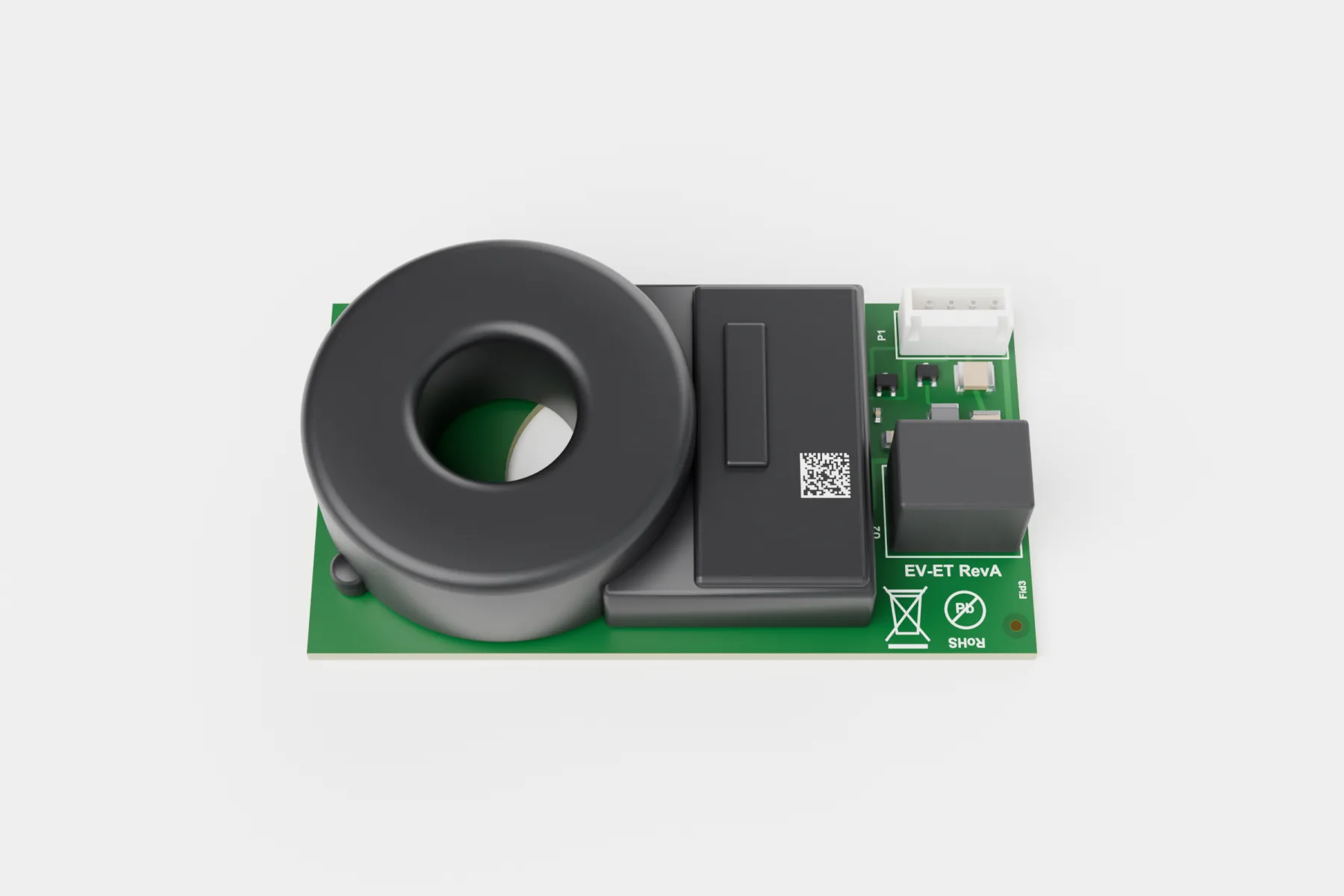
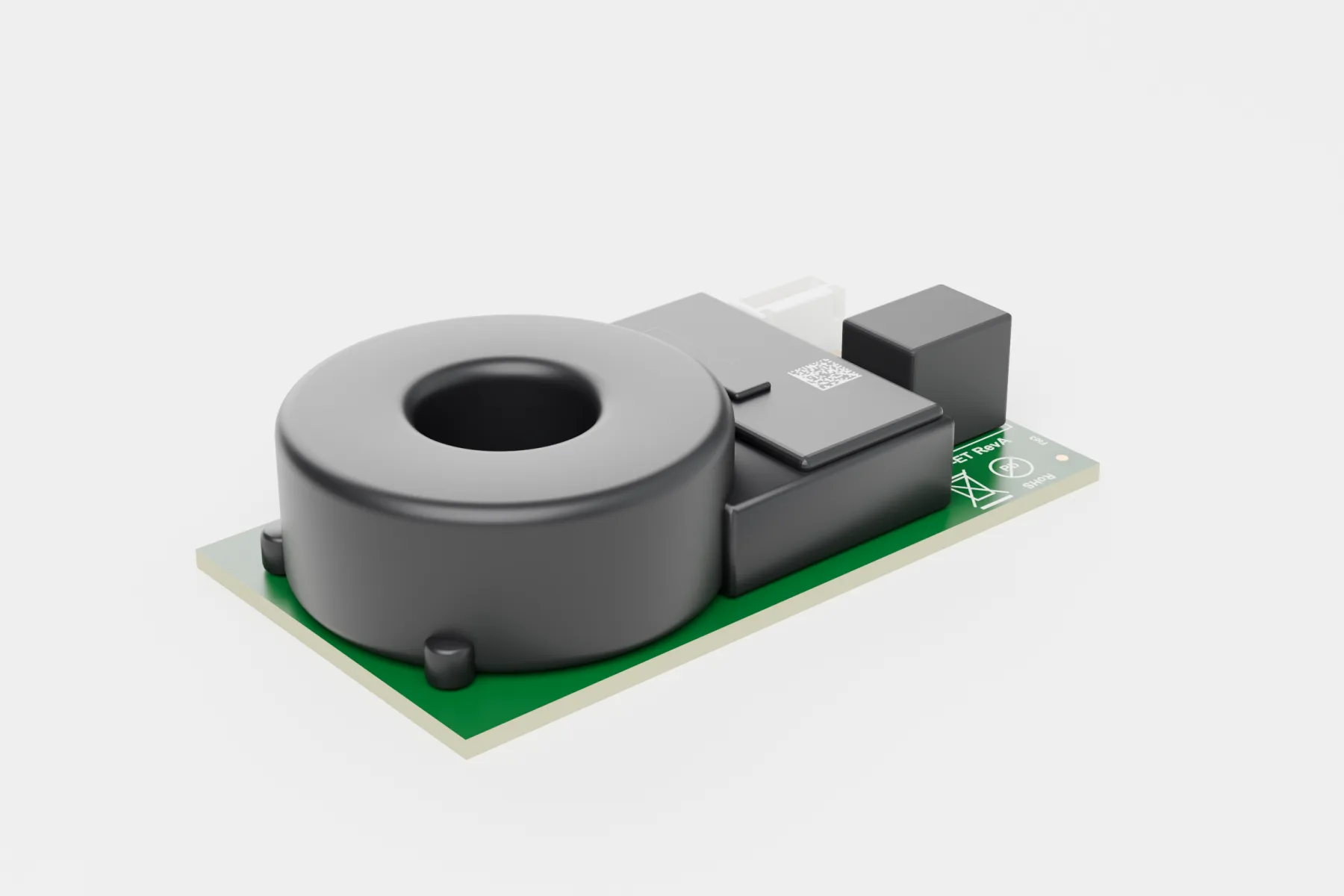
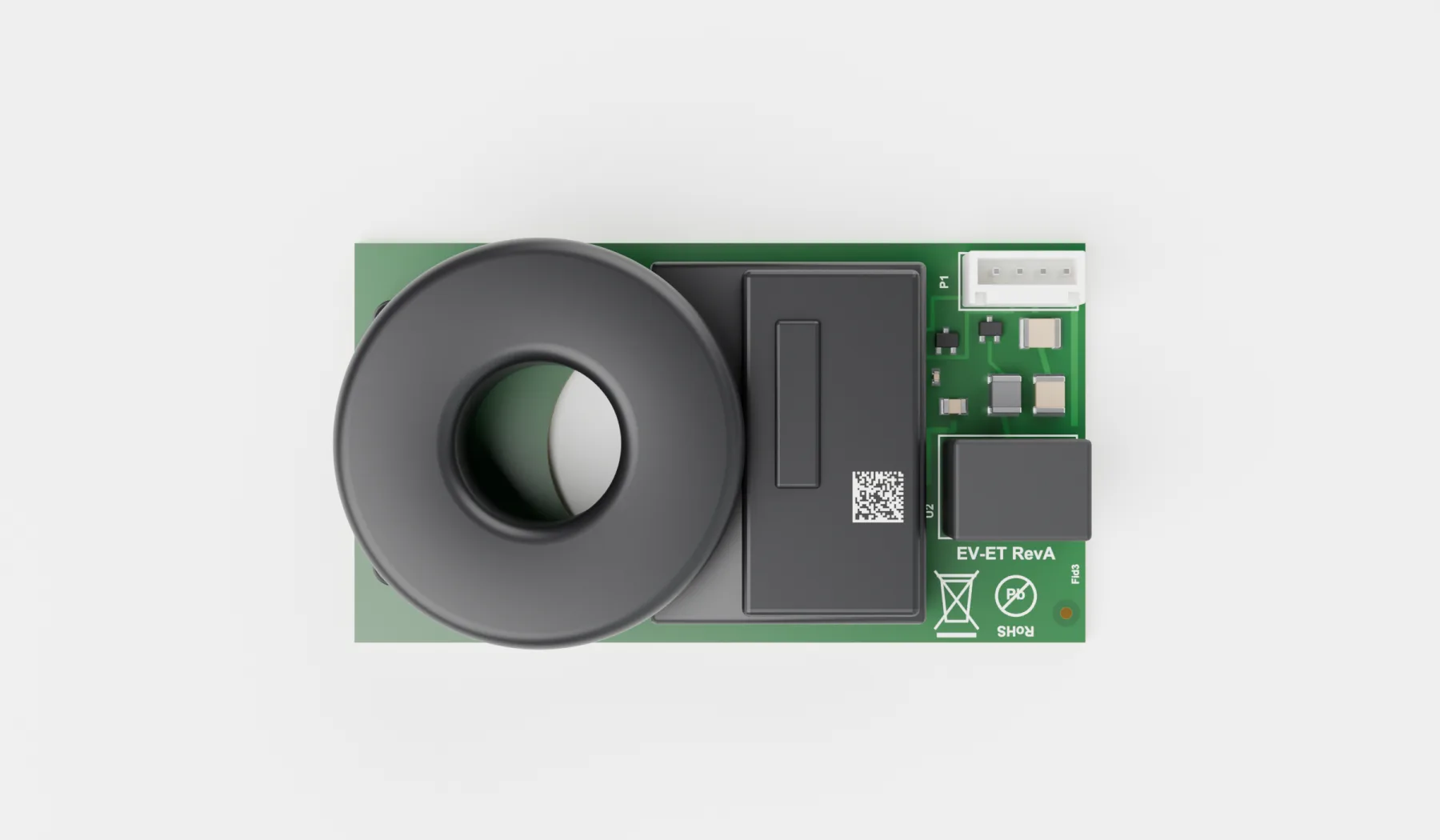
The 6 mA RDC-DD (residual direct current detecting device) A separate product, and standard with every EdgeTech charger, charge controller and DIY kit. It lets a Type A RCD be used upstream instead of a Type B (IEC 62955).
- Part number
EVSE-X-DCD- Status
- Shipped
- Made in
- Europe
- Price
- standard with every charger and charge controller; also sold separately, price on request
Specifications
| Specification | Value |
|---|---|
| Standard | IEC 62955 (RDC-DD), 6 mA DC residual current detection |
| Trip level | > 6 mA DC |
| Disconnect time | ≈ 300 ms, via the charge controller relay |
| Wiring | Neutral and all phases through the toroid; protective earth stays outside |
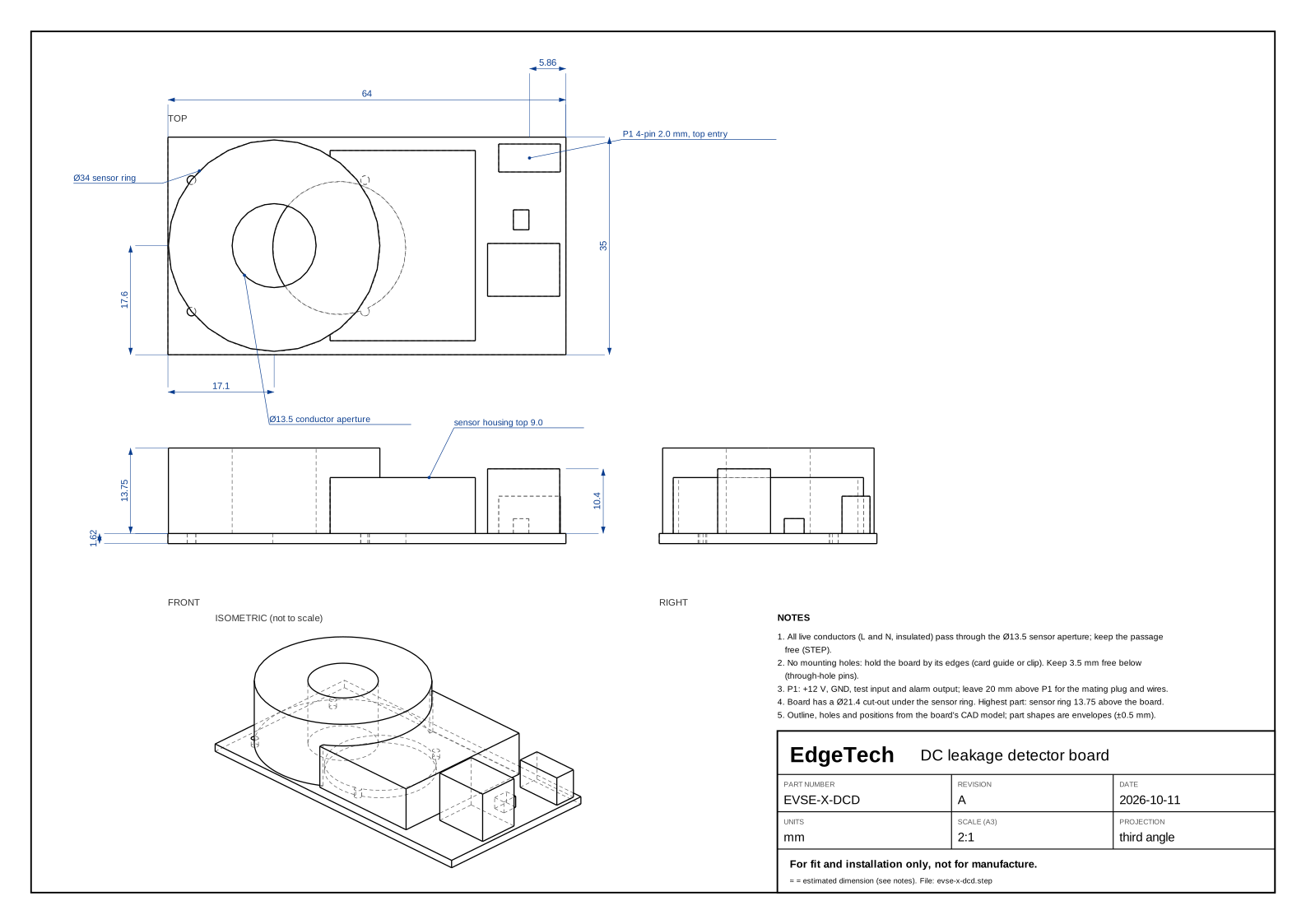
| Dimensions | Board 64 × 35 mm; sensor ring Ø34 mm, 13.75 mm high, conductor aperture Ø13.5 mm; no mounting holes, held by its edges |
| Configuration | None. No adjustable parameters. |
| Failsafe | Loss of communication with the charge controller blocks charging; trip reported as error bit 5 (value 32) in the error byte of register 0x0103 |
| When required | Every Mode 3 charge point on a Type A RCD (NEN 1010 / IEC 60364-7-722) |
| Made in | Europe |
Interfaces: connector to EVSE-C-3x32A
Standards: IEC 62955. Status of each on the standards page.
What it is
A residual DC current detector that is delivered with every EVSE-C-3x32A and built into every finished charger. The car’s onboard charger can leak DC current back into the installation; a normal Type A RCD does not see it, and its core can even be saturated by it, so that it no longer trips on a normal fault current either. The installation standard (IEC 60364-7-722; in the Netherlands NEN 1010) asks for protection against DC leakage of 6 mA and more: either a Type B RCD, or a Type A RCD together with an RDC-DD to IEC 62955 in the charge point. This module is that RDC-DD.
Not only chargers can leak DC current to PE. Solar and battery inverters without galvanic separation, and some heat-pump drives, can do the same. The installation rule is the same for all of them (IEC 60364-5-53, NEN 1010 clause 531.3.3): choose the residual-current protection by the leakage current the equipment can produce. Where smooth DC can occur, that means a Type B RCD, unless the equipment already has its own DC leakage detection or galvanic separation. For a charge point, the RDC-DD with a Type A RCD is the accepted alternative (IEC 60364-7-722).
The module has no settings. When it trips, the charge controller opens the contactor within about 300 ms, sets error bit 5 (value 32), and the MyCharger app or your own controller sees the fault in the socket status.
Installation
Route neutral and all connected phases through the toroid. Do not route the protective earth through it. Connect the module to the DCD header on the charge controller. If the controller loses communication with the module, charging is blocked until it is restored, so the module must be present when the DCL_MUST_BE_PRESENT setting is on, which is the shipped default.
CAD and drawings
For fit and installation only, not for manufacture. Outline, mounting holes, connector positions and component height envelopes; dimensions marked ≈ are estimated.
Questions
Do I still need a Type B RCD?
No. With the EVSE-X-DCD detecting DC residual current above 6 mA, the charge point may be protected by a Type A RCD (30 mA) upstream, which is what NEN 1010 asks for.
Can two charge controllers share one module?
No. One module per charge controller. A two-socket cabinet uses two controllers and two modules.