Building sites
Temporary charging on construction sites: chargers that go up and come down with the site, a temporary connection, no data cabling, load management over the air with GridShield, and an outlet box that turns a charger into a 230 V or three-phase power point.
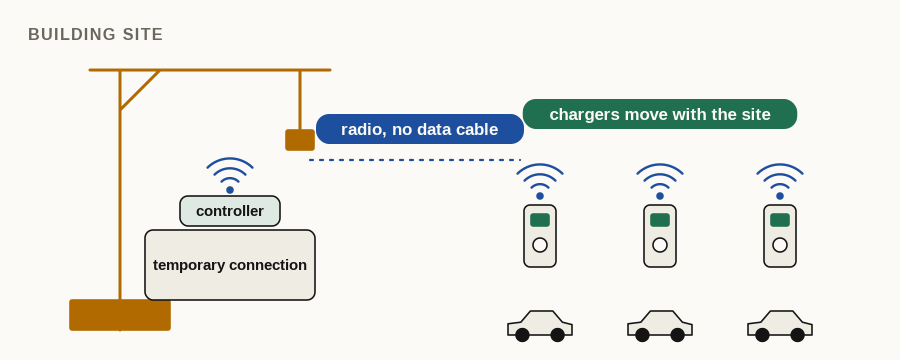
What is different on a site
The connection is temporary and often small, the chargers move, nobody wants to pull data cables through a site, and the equipment has to survive the site. The requirements list for this application is being written; ask for the current one.
What we do
GridShield controller at the site connection, receivers at the chargers, all over LoRa point-to-point. Chargers are simple grey-box units that can be moved. The platform gives the site manager the overview and the warnings.
Power outlets from a charger
The same charger that charges the site’s vans can power the tools. Our outlet box is made for public chargers: its cable has a Type 2 plug, the same plug a car cable has, so it fits any charger with a socket. It gives you sockets with current limiting:
- 230 V: ordinary wall sockets, for tools, lights and site huts;
- 3 × 230 V: a red three-phase socket, for heavier equipment.
The box obeys the current the charger advertises, just as a car does. If the tools draw more than that, the box switches off, so the charger’s load management keeps the site connection safe. Built for construction sites. Ask us about versions and prices.
Parts
Simple chargers; the outlet box; GridShield controller and receivers; the platform.