Products / EVSE-SC-02
Edge Smart Load Balancer
Current-generation site controller. Reads the DSMR/ESMR 5 smart meter through its P1 port, so it needs no clamps, sees import and export per phase, and dynamically limits up to 10 Edge charge controllers. Solar-surplus charging, WiFi, MyCharger app.
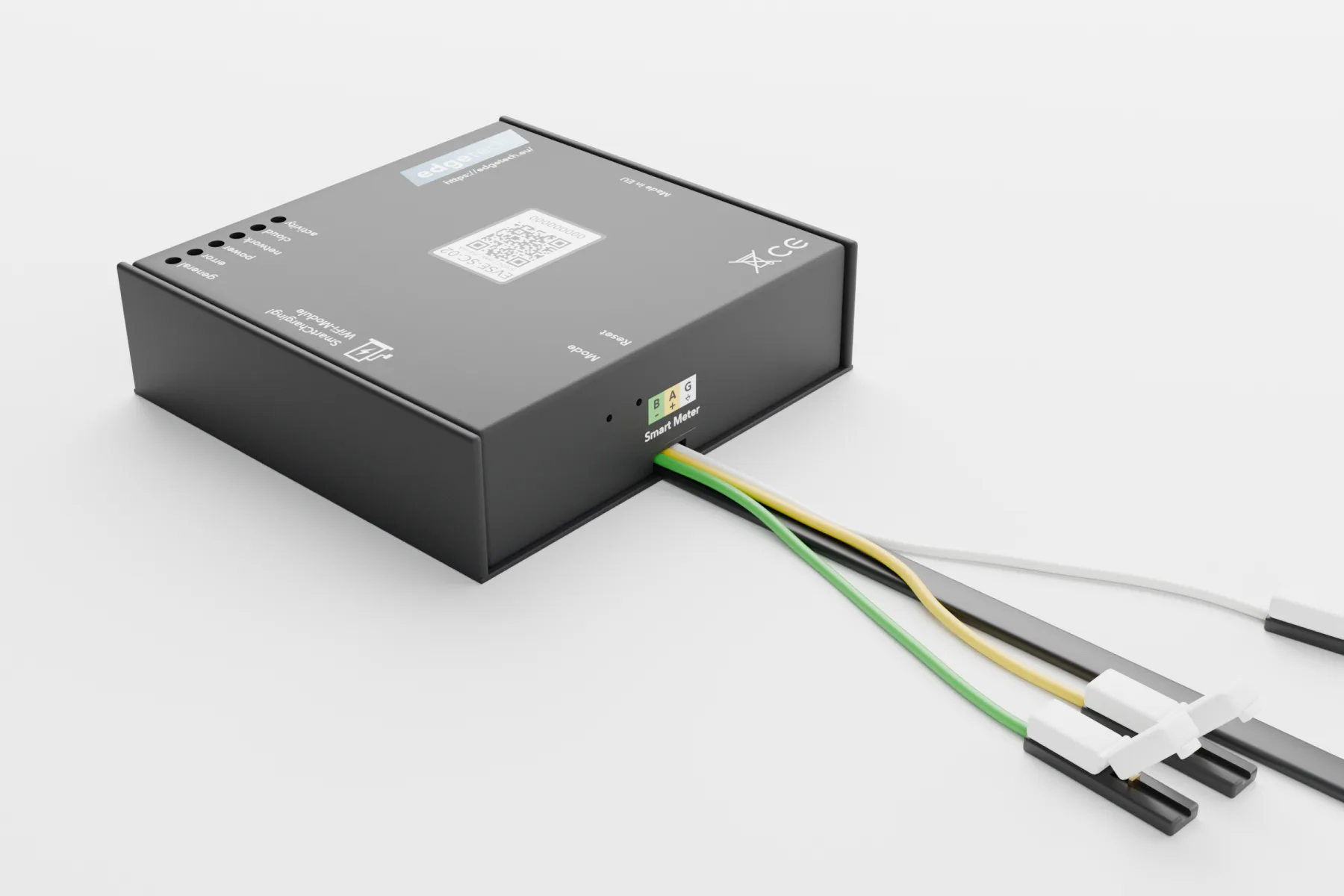
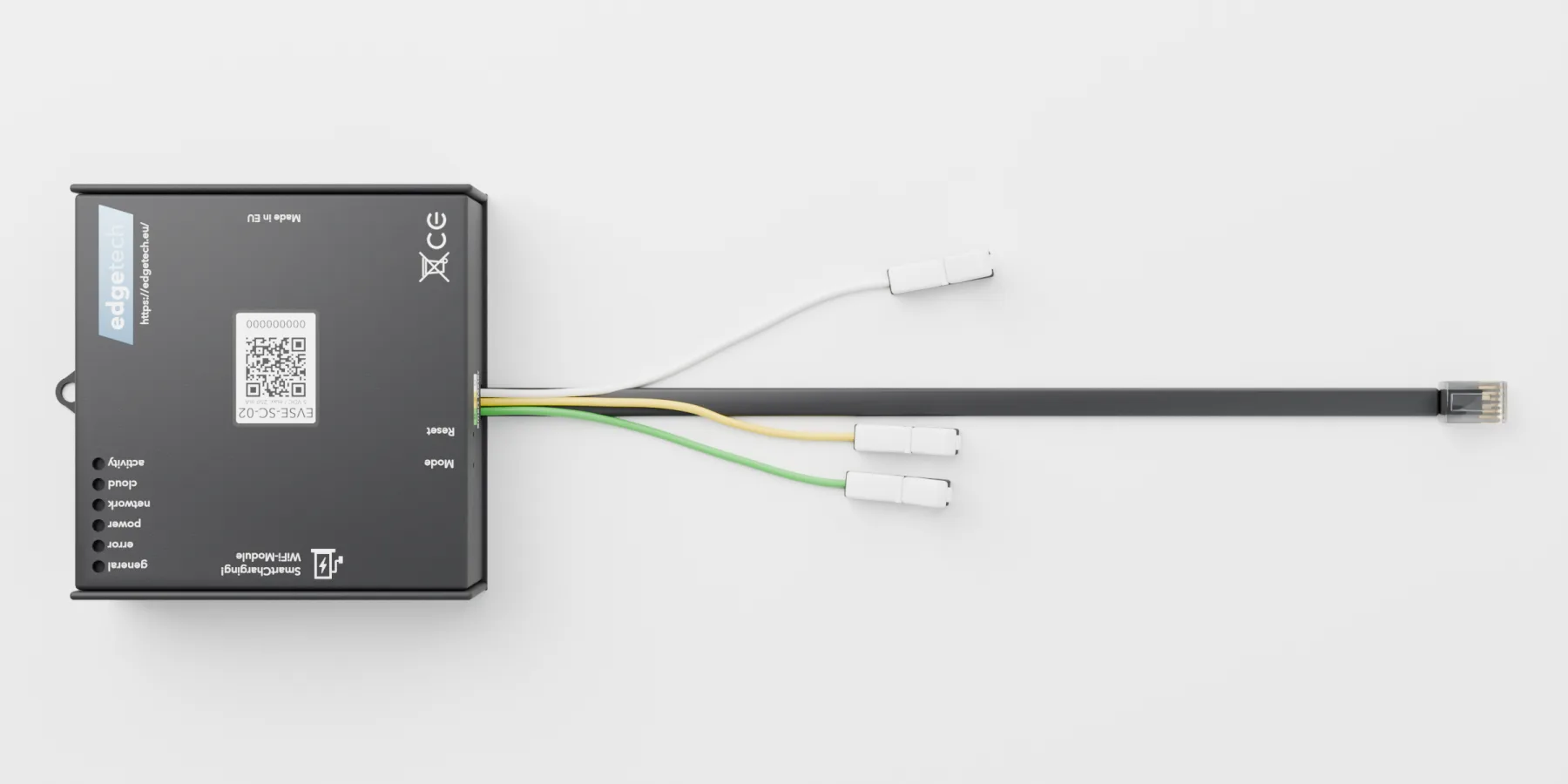
- Part number
EVSE-SC-02- Status
- Shipped
- Made in
- Europe
- Price
- € 145 excl. VAT · per unit excl. VAT, ask for a quote above 5 units
Specifications
| Specification | Value |
|---|---|
| Charge points | Up to 10 EVSE-C-3x32A on one RS485 bus (8 recommended for sites with many simultaneous sessions) |
| Site measurement | P1 port of a DSMR 5.0 / ESMR 5.0 smart meter (Netherlands, Belgium); per-phase import and export power, per-phase voltage and current |
| Load balancing | Per-second current limit per charge point; site limit, solar mode and 1P/3P per socket configurable; minimum 6 A per car, start threshold 8 A |
| Solar charging | Surplus mode charges only on export; solar-assist mode tops up from the grid. Uses meter export values, not clamps. |
| Fieldbus | Modbus RTU master, RS485, 19200 8N1 (switches fresh charge controllers from 9600 automatically) |
| Bus cable | 3 × 0.75 mm² multi-core (stranded). No solid-core cable and no raw Ethernet cable in the terminals; Ethernet only with RJ45 connectors (adapter board on request) |
| Connectivity | WiFi IEEE 802.11 b/g/n, 2.4 GHz only; MQTT over TLS with a per-device pre-shared key |
| Module | WiFi module (2.4 GHz) |
| Supply | From the P1 port (meter must supply ≥ 250 mA) or 5 V via micro-USB |
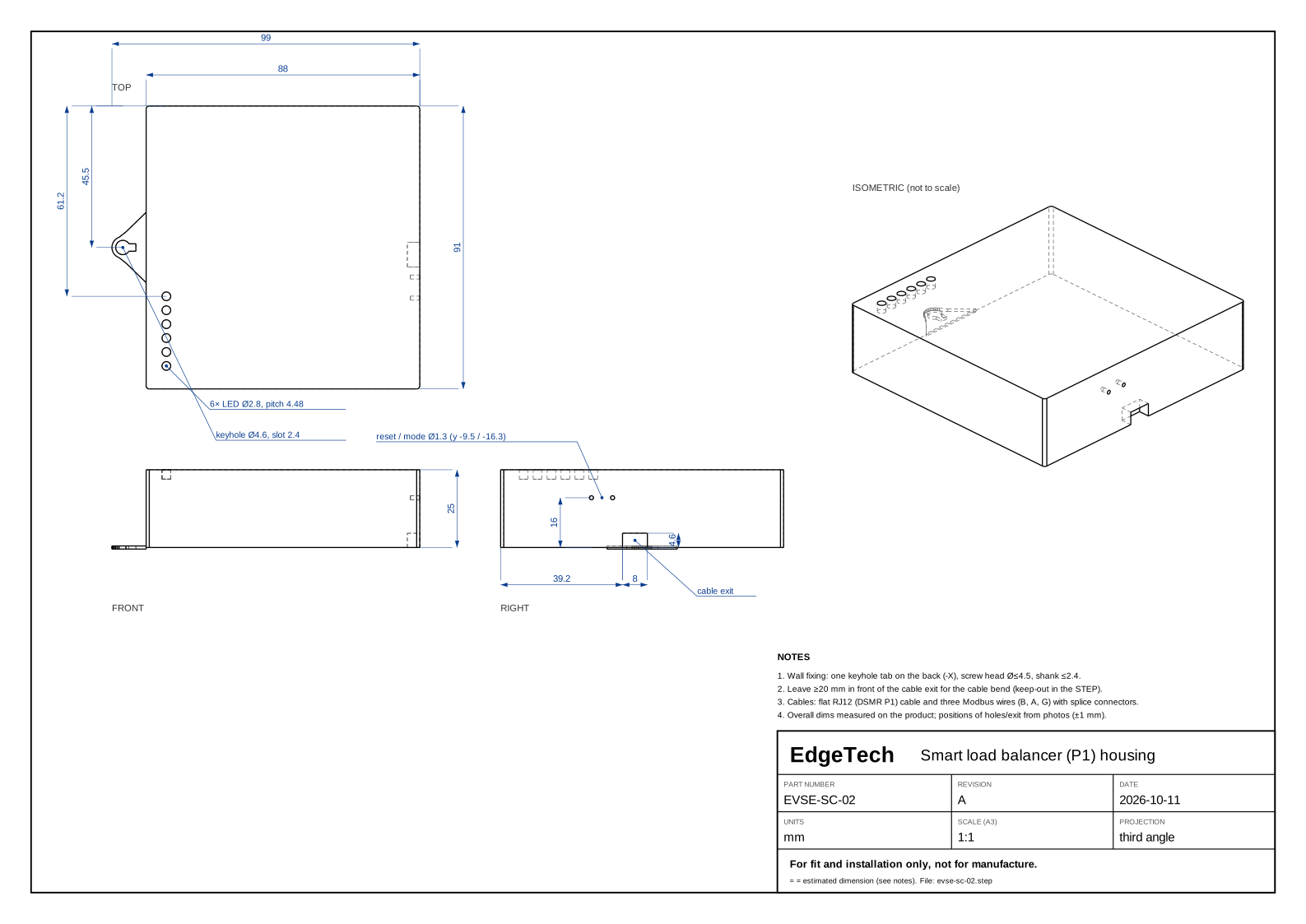
| Dimensions | 88 × 90 × 25 mm, mounted next to the meter, not inside the distribution board |
| Setup | WiFi credentials via the Mode pinhole (hold 3 s) and the MyCharger app; restart by unplugging the RJ12 for 3 s |
| CE | EU declaration of conformity on request |
| Made in | Europe |
Interfaces: P1 (RJ12) DSMR/ESMR 5, Modbus RTU RS485 master, WiFi 2.4 GHz, micro-USB power
Standards: DSMR 5.0 / ESMR 5.0 P1, Modbus RTU, EN 300 328, EN 301 489. Status of each on the standards page.
What it is
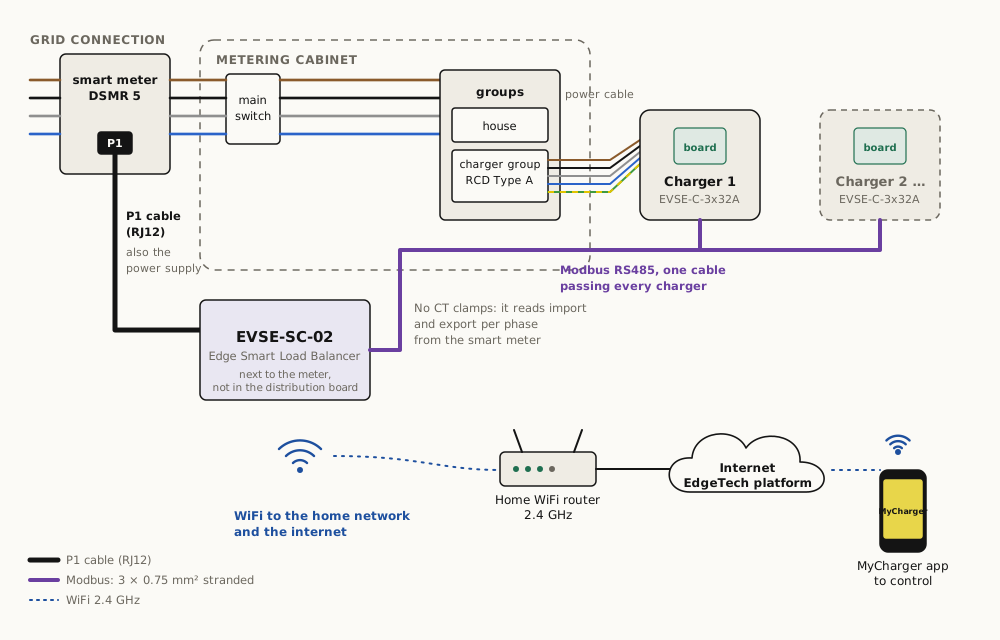
The site controller EdgeTech ships today. Plug it into the P1 port of the smart meter and it knows, every second, what the whole installation draws or exports on each phase. From that it gives each charge controller a current limit, once per second, over RS485.
Because it reads the meter instead of clamps, it sees the direction of current. That makes solar-surplus charging work: the car is charged from what the roof produces, and the grid limit is respected at the same time.
What the P1 telegram gives us
The SC-02 uses these fields from the DSMR/ESMR 5 telegram, at 1 s intervals: per-phase instantaneous power delivered and returned, per-phase voltage and current, and the meter’s cumulative registers for consumption reporting. The full list of OBIS codes is on the P1 telemetry page.
Solar modes
| Mode | Behaviour |
|---|---|
| Off | Charge at the maximum the site allows, regardless of PV |
| Solar assist | Prefer PV surplus, top up from the grid so the car always charges at ≥ 6 A |
| Solar only | Charge only on PV surplus; pause below 6 A surplus (3-phase: 3×6 A) |
Switching a session between 1-phase and 3-phase to widen the solar window is done per socket with a 10 s pause, the same behaviour EdgeTech contributed to evcc.
Limits
- 2.4 GHz WiFi only; limited to 100 platform messages per day per device to keep the shared platform quiet.
- The RS485 bus runs at 19200 baud; charge controllers at 9600 are switched automatically on first contact.
- Up to 10 charge controllers on one bus. Above that, split the site over two SC-02 units on two P1 splitter ports, or use GridShield.
Installation: the installation manual for the EVSE-SC-02 (PDF), step by step with figures.
Installation
CAD and drawings
For fit and installation only, not for manufacture. Outline, mounting holes, connector positions and component height envelopes; dimensions marked ≈ are estimated.
Questions
Which smart meters work?
Any DSMR 5.0 or ESMR 5.0 meter with a P1 port, which is every meter installed in the Netherlands since about 2016, and Belgian Fluvius meters. Older DSMR 4 meters send too slowly and do not power the port. Austrian meters use a different, encrypted P1 and are not supported.
The P1 port is already used by another device.
Use a powered P1 splitter. The SC-02 needs at least 250 mA from the port; if the meter cannot supply it, power the SC-02 over micro-USB.
Can it drive third-party chargers?
Not directly. It drives Edge charge controllers over Modbus. To limit third-party chargers or a heat pump, use the GridShield receiver, which has Modbus, relay and SG-Ready outputs.