Products / EDGE-CH-D
Charger with display
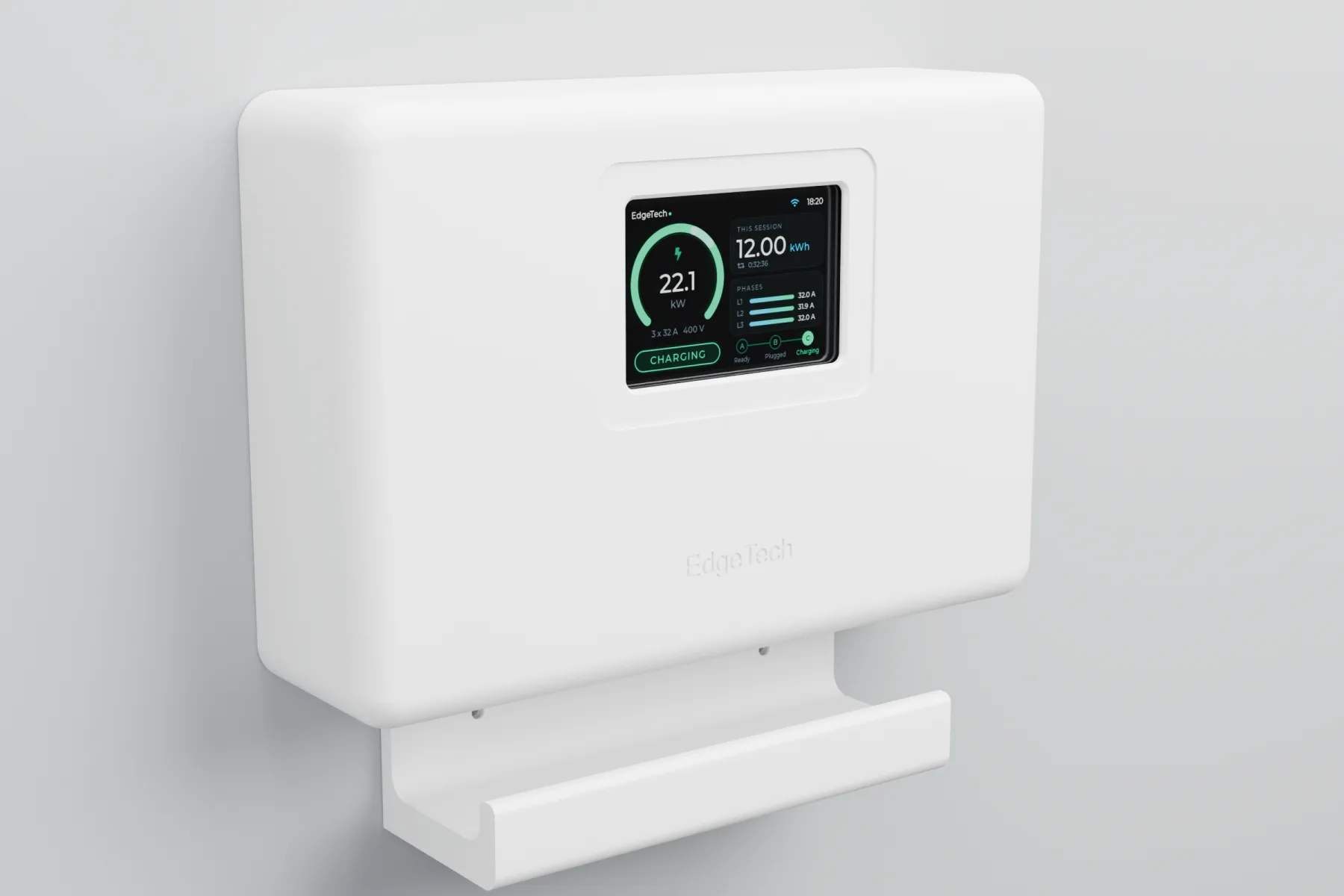
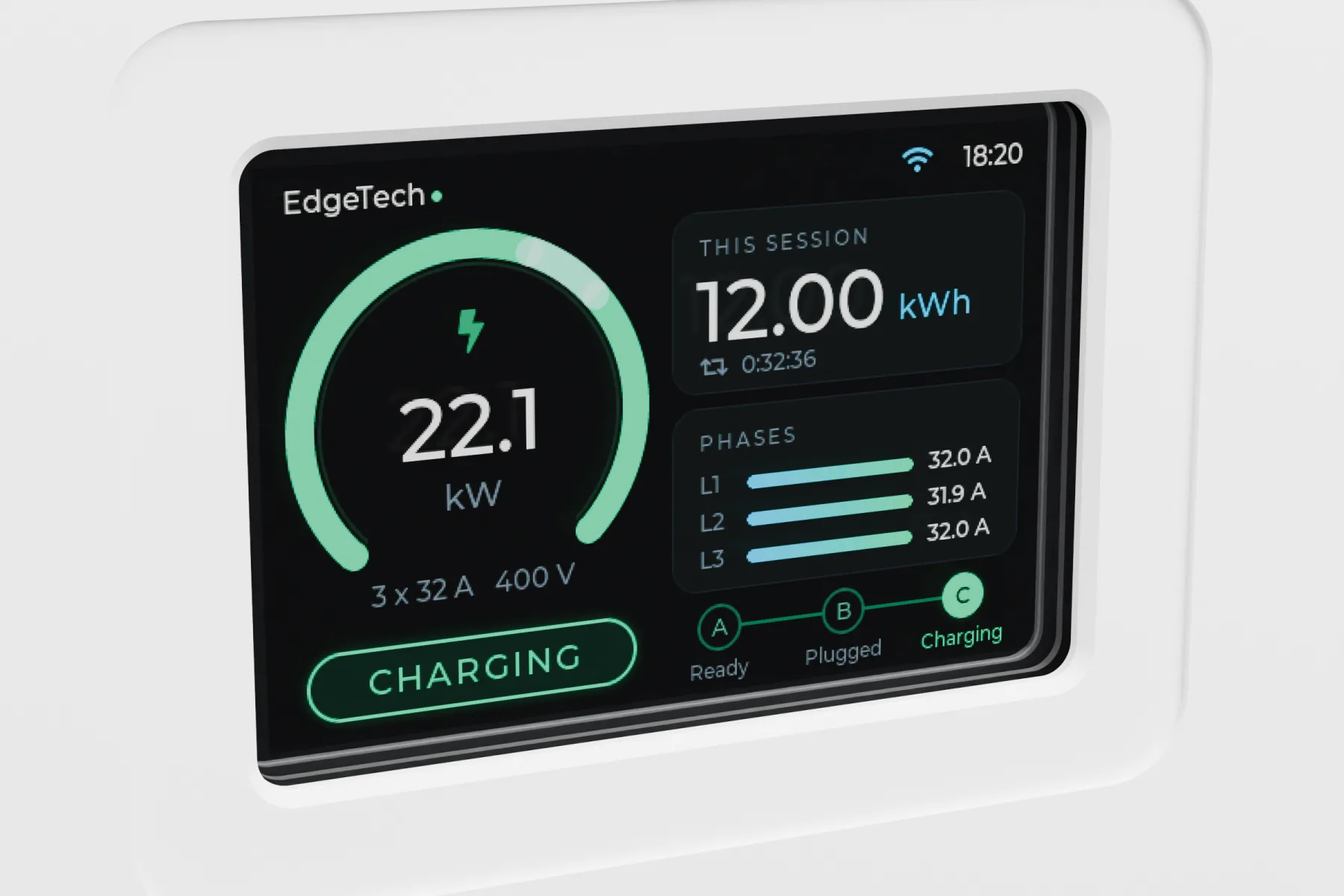
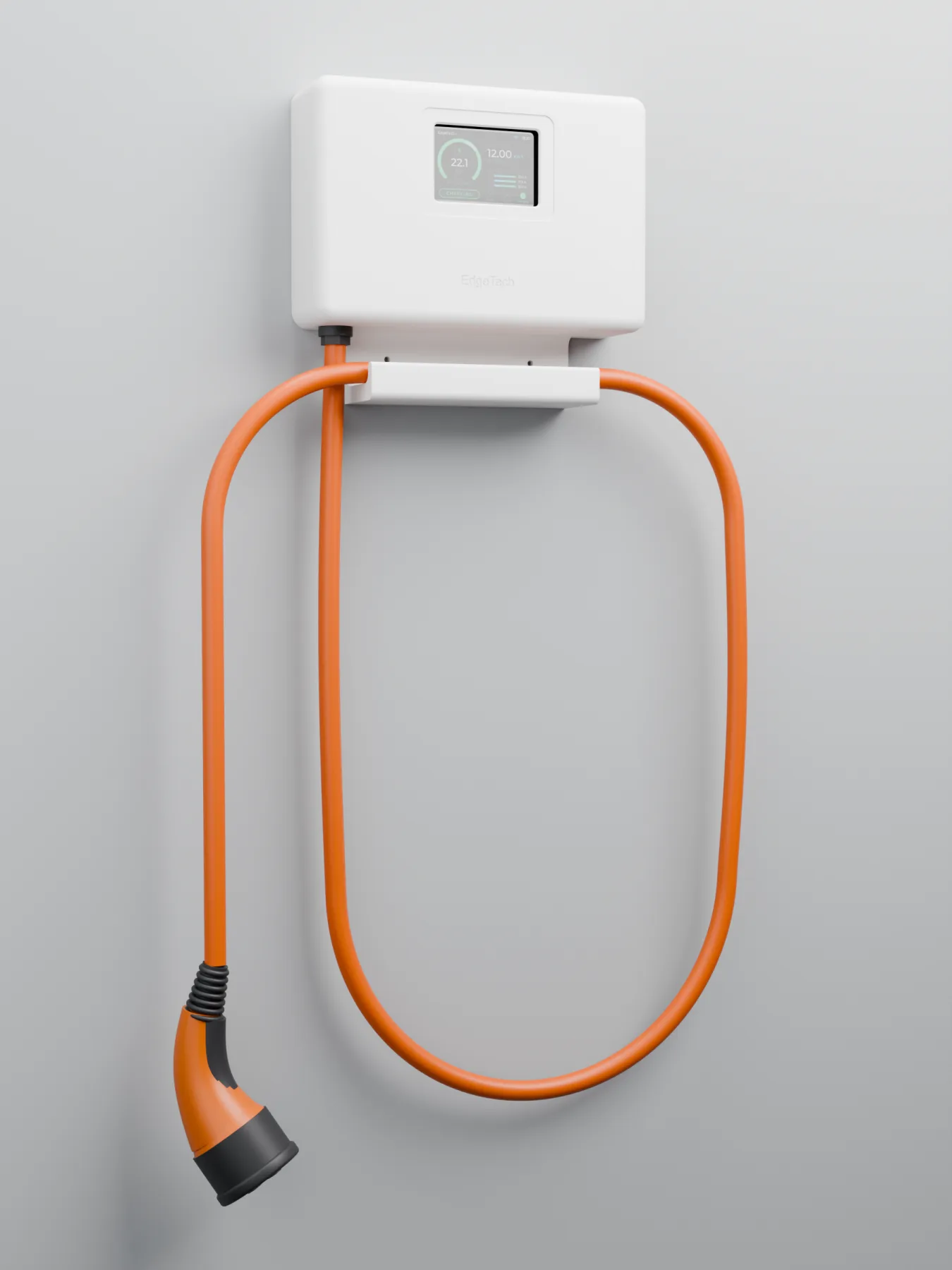
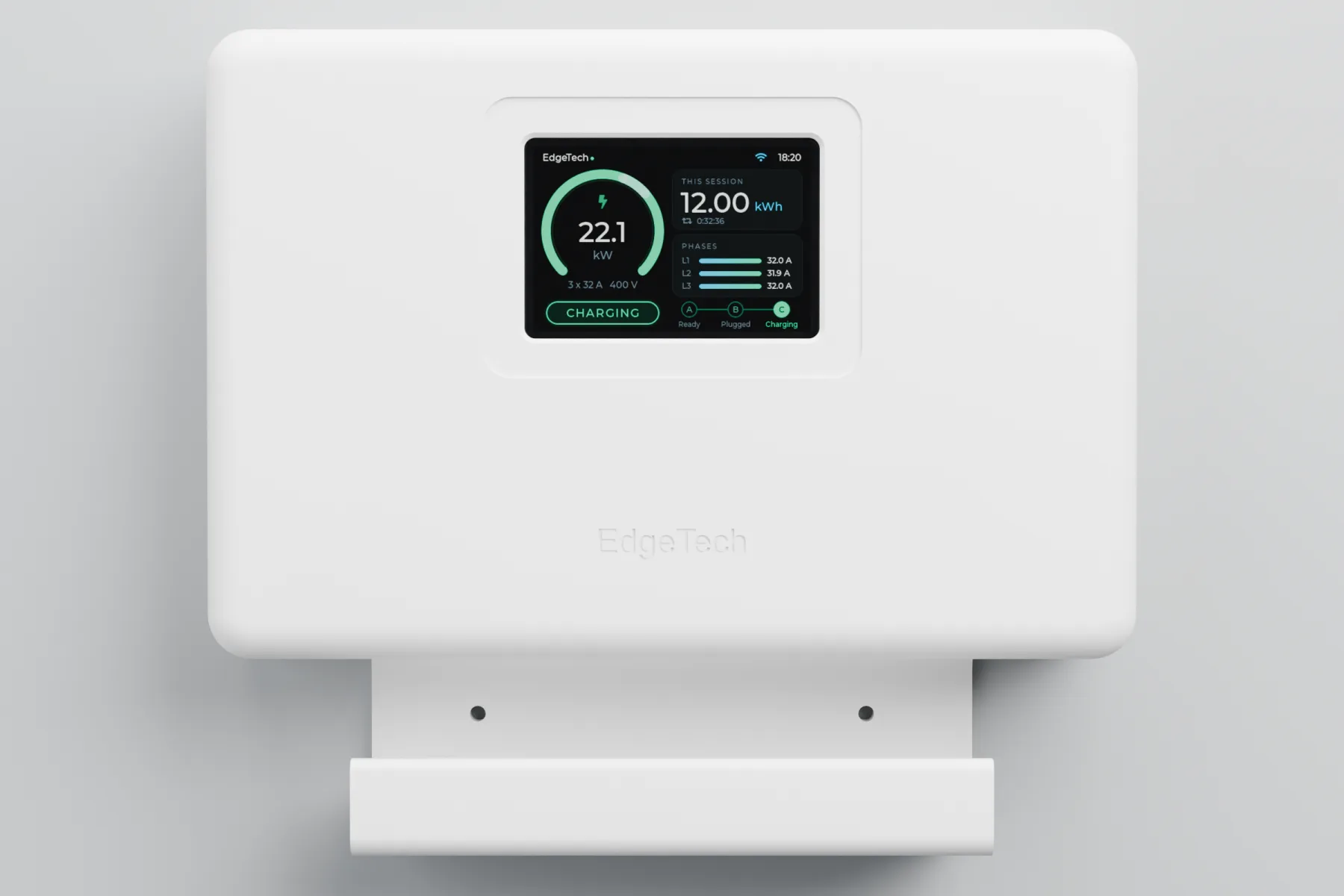
Our main charger: the same grey box and electronics as the simple charger, with a transparent lid and a display behind it that shows charging state, current and energy. Use it as it is, or with your own shroud or front: a white-label charger under your name, with the MyCharger app under your name if you want it. From there it is a short way to your own enclosure and electronics through engineering.
- Part number
EDGE-CH-D- Status
- Shipped
- Manufactured
- Boards and assembly in the Netherlands / EU
- Price
- on request
Lead time: Standard: produced to order, confirmed with the quotation. Own shroud: first batch 8–12 weeks after design freeze (indicative); repeat batches 4–6 weeks
Specifications
| Specification | Value |
|---|---|
| Display | Behind a transparent lid; shows state, current per phase, session energy; content to be confirmed |
| Shroud / front | Standard grey box, or your own shroud or front on the same box |
| Charge points per unit | 1 or 2, each on its own EVSE-C-3x32A and EVSE-X-DCD |
| Power | 1-phase 16 A or 32 A, or 3-phase up to 32 A (22 kW) per charge point |
| Connector | Type 2 socket with lock, or fixed Type 2 cable (5 m or 7.5 m) |
| Protection | DC leakage 6 mA (RDC-DD, IEC 62955) on board; upstream Type A RCD 30 mA and MCB per charge point supplied by the installer or built in |
| Load balancing | Dynamic per-second limiting with EVSE-SC-02 (P1) or EVSE-SC-01 (clamps), or wireless with GridShield |
| App and platform | MyCharger app (iOS, Android): start/stop, off-peak schedules, solar modes, consumption overview, automatic invoicing. Installer diagnostics and OTA updates. |
| Signalling | RGB status LED or addressable LED light ring, colours configurable |
| Authorisation | Plug and charge, app start, scheduled. RFID on request. |
| Metering | On-board metering (not MID). MID meter as an option for billing. |
| CE | Charge controller and site controller carry their own EU declarations of conformity; updated declarations (EN IEC 61851-1:2019, EN IEC 61851-21-2:2021, RED with EN 18031) soon. The assembled unit is declared by the party placing it on the market; we supply the technical file. |
| Manufactured | Boards and assembly in the Netherlands / EU |
What is configurable
| Option | Choices |
|---|---|
| Shroud | Standard grey box, your own shroud or front, or your own enclosure |
| Branding | Front label, LED colours, app name and icon (white-label MyCharger), splash and support contact |
| DC leak sensor (RDC-DD) | Standard, included with every charge point |
| Charge points | 1 or 2 per unit; up to 10 per site controller |
| Connector | Socket with lock; fixed cable 5 m or 7.5 m |
| Phases | 1-phase 16/32 A, 3-phase 32 A; per-socket 1P/3P switching for solar |
| Site measurement | P1 (SC-02), CT clamps (SC-01), GridShield wireless, or none |
| Firmware defaults | Modbus address, lock type, LED type, CP disconnect behaviour, min/max current |
| Metering | On-board, or external MID meter |
| Platform | EdgeTech-hosted platform, or your own instance of the charging platform (on-premise deployable) |
| NFC reader | With or without |
Who it is for
Sites where the user wants to see what the charger is doing without opening the app: company car parks, VvE garages, and installers who prefer to read the state at the box.
Your own shroud
The display charger is also the base for a charger under your own name. Keep the box and electronics, and put your own shroud or front on it, with or without status lights. The MyCharger app can carry your name too.
It is the same charger that is already in the field in several thousand charge points under other brands: the same charge controller, RDC-DD and site controller, assembled and tested, with your name on it.
You do not need to know anything about control pilots, contactors, DC leakage, Modbus or over-the-air updates. You need to know what shroud you want, how many charge points, and whether you want the app under your own name.
The reference build
| Part | Function |
|---|---|
| EVSE-C-3x32A | Charge controller: pilot, contactor, metering, Modbus |
| EVSE-X-DCD | 6 mA DC leakage detection |
| Contactor 4P 40 A | Switching, driven by the controller |
| Type 2 socket with lock, or fixed cable | Vehicle connection |
| EVSE-SC-02 (per site) | P1 site controller: load balancing, WiFi, platform |
| Enclosure | Wall box or pole, IP54 or better |
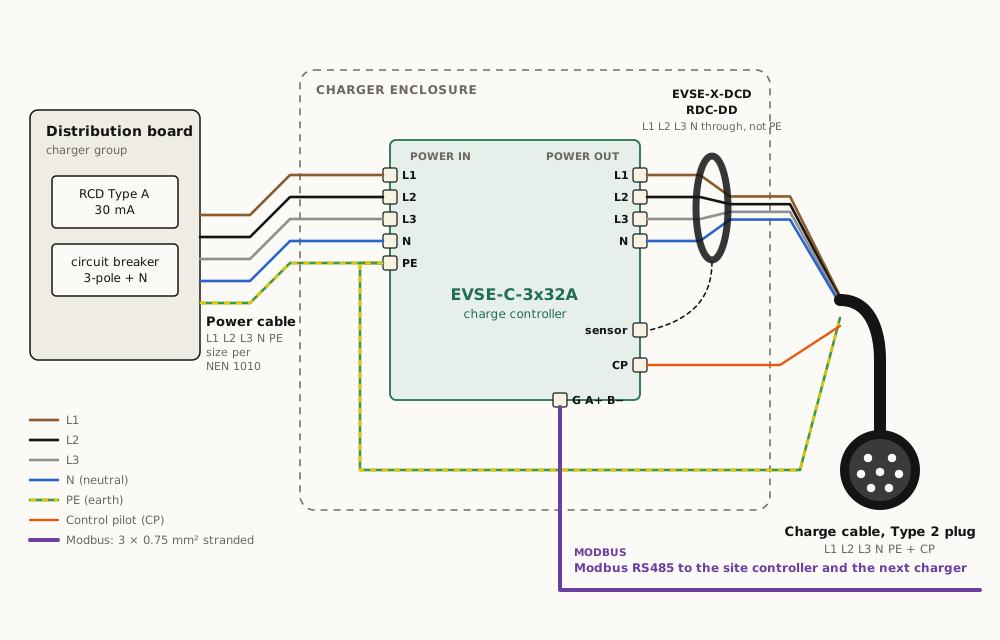
Every part in this table is specified, sourced and tested. The bill of materials, wiring diagram and assembly instructions are part of the technical file you receive.
Lead times
Indicative. First batch 8 to 12 weeks after the design is frozen, of which most is enclosure tooling and the assembled-unit tests. Repeat batches 4 to 6 weeks. Boards are stocked; the enclosure is usually the long pole.
From white-label to your own
Most OEM customers start with the reference build. When volumes grow, they take the engineering route and design their own enclosure and electronics around the same boards. The boards, firmware and platform stay the same, so nothing in the field has to change.
Installation
CAD and drawings
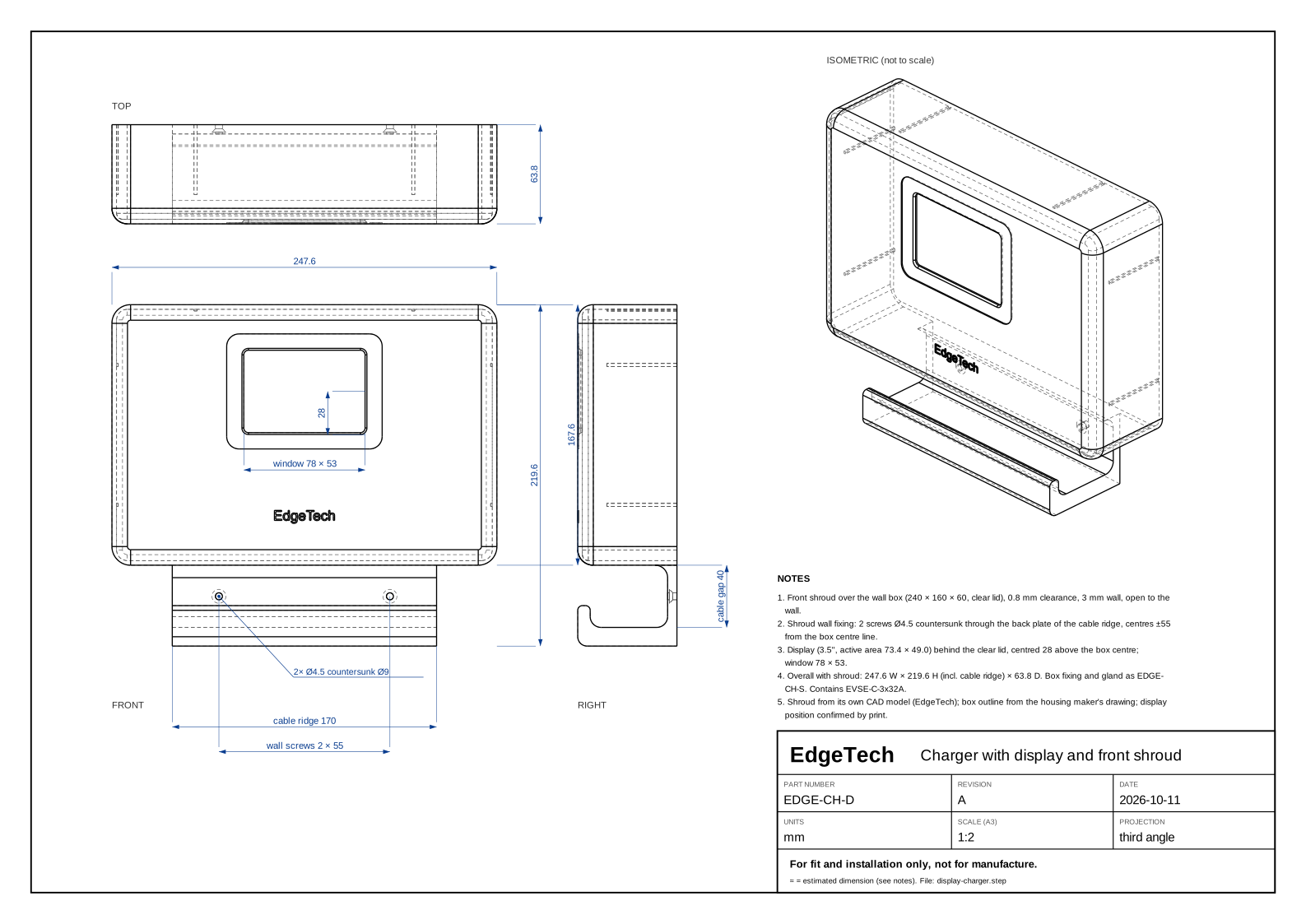
For fit and installation only, not for manufacture. Outline, mounting holes, connector positions and component height envelopes; dimensions marked ≈ are estimated.
Questions
Who installs and services it?
Any qualified electrician can install it; the installation manual is on this site. We also work with a group of certified installers across the Netherlands who install and service our chargers. Ask us and we put you in touch.
What is the minimum order?
There is no hard minimum for the reference enclosures. A custom enclosure or a white-labelled app is worth it from roughly 50 units a year; below that we recommend the reference build with your label.
Who signs the CE declaration of the finished charger?
The company that places the charger on the market under its name. EdgeTech supplies the declarations of the boards, the technical documentation of the reference build, and if wanted, does the assembled-unit testing with you.
Can we run the backend ourselves?
Yes. The charging platform can be deployed on a single server inside your own network, with no dependency on our cloud. It was built for telecom customers who run their own vulnerability scans and cannot depend on external services.